The Fish River Canyon is the second largest canyon in the world and the largest in Africa, as well as the second most visited tourist attraction in Namibia. It is located in the south of Namibia. It is about 160 km long, up to 27 km wide and in places almost 550 metres deep. The Fish River is the longest interior river in Namibia. It cuts deep into the plateau which is today dry, stony and sparsely covered with hardy drought-resistant plants. The river flows intermittently, usually flooding in late summer; the rest of the year it becomes a chain of long narrow pools. At the lower end of the Fish River Canyon, the hot springs resort of Ai-Ais is situated. Public view points are near Hobas, a camp site 70 km north of Ai-Ais. This part of the canyon is part of the Ai-Ais/Richtersveld Transfrontier Park. The other 90 km of this canyon are privately owned.
Tuesday, 13 September 2011
Sunday, 11 September 2011
Victoria Falls
The Victoria Falls or Mosi-oa-Tunya is a waterfall located in southern Africa on the Zambezi River between the countries of Zambia and Zimbabwe. The falls are the largest in the world. Its height is 108 meters. Victoria Falls is roughly twice the height of North America's Niagara Falls and well over twice the width of its Horseshoe Falls. In height and width Victoria Falls is rivaled only by South America's Iguazu Falls. See table for comparisons.
An aerial image of Victoria Falls
Lake Saiful Muluk
Lake Saiful Muluk is a lake located at the northern end of the Kaghan Valley near Naran. It is in the north east of Mansehra District in the Khyber-Pakhtunkhwa province of Pakistan. At an altitude of 3,224 meter above sea level it is amongst one of the highest lakes in Pakistan. The weather here is moderate during day time while the temperature drops to minus degrees at night. A fairy tale called Saiful Muluk, written by the famous Sufi poet Mian Muhammad Bakhsh, is associated with the lake. It is the story of prince of Persia who fell in love with a fairy princess at the lake. The impact of the lake beauty is of such extent that people believe that fairies come down to lake in full moon. A poet and writer from Balakot Ahmad Hussain Mujahid wrote the story of Saiful Muluk in prose depicting the local version.
Picture of Lake Saiful Muluk
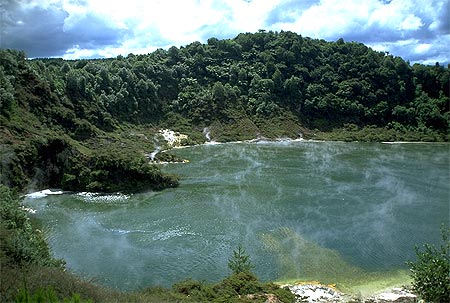
Frying Pan Lake, New Zealand
Frying Pan Lake is the largest hot spring in the world. It is located in Waimangu Volcanic Rift Valley, New Zealand. 38,000 square metres in area, and fed by numerous acid springs. The lake fills part of a crater formed by the 1886 Tarawera eruption. It has a flat floor, mainly about 6 metres deep, although some vents are up to 20 metres deep. Lake temperature is generally between 45 and 55°C.
Image of Frying Pan Lake
Dominica's Boiling Lake
Dominica's Boiling Lake is situated in the Morne Trois Pitons National Park - Dominica's World Heritage site. It is a flooded fumarole 10.5 km east of Roseau, Dominica. It is filled with bubbling greyish-blue water that is usually enveloped in a cloud of vapour. The lake is approximately 200 ft across. There is no road leading directly to the lake. It is approximately a 13 kilometer hike to the lake from the nearest road, passing sulfur springs, over mountains and through gorges along the way. The first recorded sighting of the lake was in 1870 by Mr. Watt and Dr. Nicholls, two Englishmen working in Dominica at that time. In 1875, Mr. H. Prestoe, a government botanist, and Dr. Nicholls were commissioned to investigate this natural phenomenon. They measured the water temperature and found it to range from 180 to 197 degrees Fahrenheit along the edges, but could not measure the temperature at the centre where the lake is actively boiling. They recorded the depth to be greater than 195 ft. Periodically, there have been fluctuations in the level and activity of the lake. It was all but empty in June 2006, however as of January 2009 the lake is full and boiling vigorously.On July 6, 2007, adventure-film maker George Kourounis became the first person to ever cross the boiling lake from above, suspended by ropes over the most violently boiling section. This event was filmed for the TV series Angry Planet.
Image of Dominica's Boiling Lake
Pemanggil Island, Malaysia
Pemanggil Island is situated next to Tioman, requires a 4 to 5 hour ride by boat from Mersing. To get to Mersing itself takes 4½ hours by car or roughly 6 hours by coach from Kuala Lumpur. As with most inhabited islands in Malaysian waters, Pemanggil has its fair share of history, mystery and spooky tales. The island is fishermen's best-kept secret. It is known for deep-sea fishing and good hunting grounds for marlins and mackerels. This remote island is also famed for the beauty and abundance of marine life within its clear emerald waters. Its other magnetic charms include endless stretches of white sandy beaches and awesome snorkeling spots. Fishing and diving is excellent here. For the adventurous, the hill outcrop of the island makes for a challenging climb and the summit holds an inherent scenic beauty of the far reaching ocean.
Image of Pemanggil Island
Saturday, 10 September 2011
Aconcagua
Aconcagua is the highest mountain in the South America. Its height is 6,962 m. It is located in the Andes mountain range, in the Argentine province of Mendoza and it lies 112 km west by north of its capital, the city of Mendoza. Aconcagua is the highest peak in both the Western and Southern Hemispheres. It is one of the Seven Summits. The mountain and its surroundings are part of the Aconcagua Provincial Park. The mountain has a number of glaciers. The largest glacier is the Ventisquero Horcones Inferior at about 10 km long which descends from the south face to about 3600m altitude near the Confluencia camp. Two other large glacier systems are the Ventisquero de las Vacas Sur and Glaciar Este / Ventisquero Relinchos system at about 5 km long. However the most well-known is the north-eastern or Polish Glacier, a common route of ascent.Over 135 climbers have died on Aconcagua, most by complications of altitude sickness as well as by falls, heart attacks, and hypothermia. The first fatality was Austrian Juan Stepanek in 1926. An average of three climbers dies each year on Aconcagua.
Image of Aconcagua
Image of Aconcagua
Image of Aconcagua
Image of Aconcagua
Subscribe to:
Posts (Atom)